Breaking the Language Barrier: An In-Depth Look at Real-Time AI Multimodal Translation Tools

The Evolution of Global Communication: The Dawn of Multimodal Translation
For centuries, language barriers have stood as the final frontier in global human interaction, limiting the exchange of ideas, commerce, and culture. While traditional translation tools like Google Translate revolutionized text-based communication, they often lacked the speed and nuance required for fluid, human-like interaction. However, we are currently witnessing a paradigm shift with the emergence of real-time AI multimodal translation tools. These sophisticated systems do not merely translate text; they process and synthesize multiple forms of input—speech, text, vision, and even gestures—to provide a seamless and instantaneous bridge between speakers of different languages.
Multimodal AI represents the cutting edge of machine learning, where models are trained on diverse datasets to understand context in a way that mimics human perception. As businesses become more globalized and international travel reaches new heights, the demand for technology that can interpret the world in real-time has never been higher.




Defining Real-Time Multimodal AI Translation
To understand the significance of this technology, one must first define what makes it ‘multimodal.’ Traditional translation is unimodal, focusing typically on one input type (e.g., typing a sentence to receive a translated text). Multimodal translation, conversely, utilizes a combination of sensory inputs. For instance, a multimodal AI can ‘listen’ to a speaker, ‘see’ their facial expressions to gauge sentiment, and ‘read’ any physical signage or documents they are holding, providing a translated output that is far more accurate than a simple word-for-word substitution.

These tools rely on three core technological pillars: Automatic Speech Recognition (ASR), Neural Machine Translation (NMT), and Text-to-Speech (TTS). When combined with Computer Vision (CV), these systems can translate live video feeds, allowing a user to point a camera at a menu in Tokyo and see the English text overlaid perfectly on their screen, or hold a conversation where the AI mimics the original speaker’s voice in a different language.
Leading Innovations and Key Players in the Industry
The landscape of real-time translation is being shaped by both tech giants and specialized startups. OpenAI’s GPT-4o (the ‘o’ standing for Omni) is perhaps the most prominent recent example of a native multimodal model. Unlike its predecessors, which had to convert audio to text before translating, GPT-4o processes audio directly, allowing it to understand tone, multiple speakers, and background noise with sub-second latency. This enables a conversation that feels natural, without the awkward pauses that plagued previous generations of translation software.
Meta has also made significant strides with its ‘SeamlessM4T’ project. This all-in-one multilingual multimodal AI model can perform speech-to-speech, speech-to-text, text-to-speech, and text-to-text translations for nearly 100 languages. Meta’s focus on ‘seamless’ integration aims to facilitate real-time communication in the metaverse and across its social platforms, potentially making language differences irrelevant in digital social spaces.
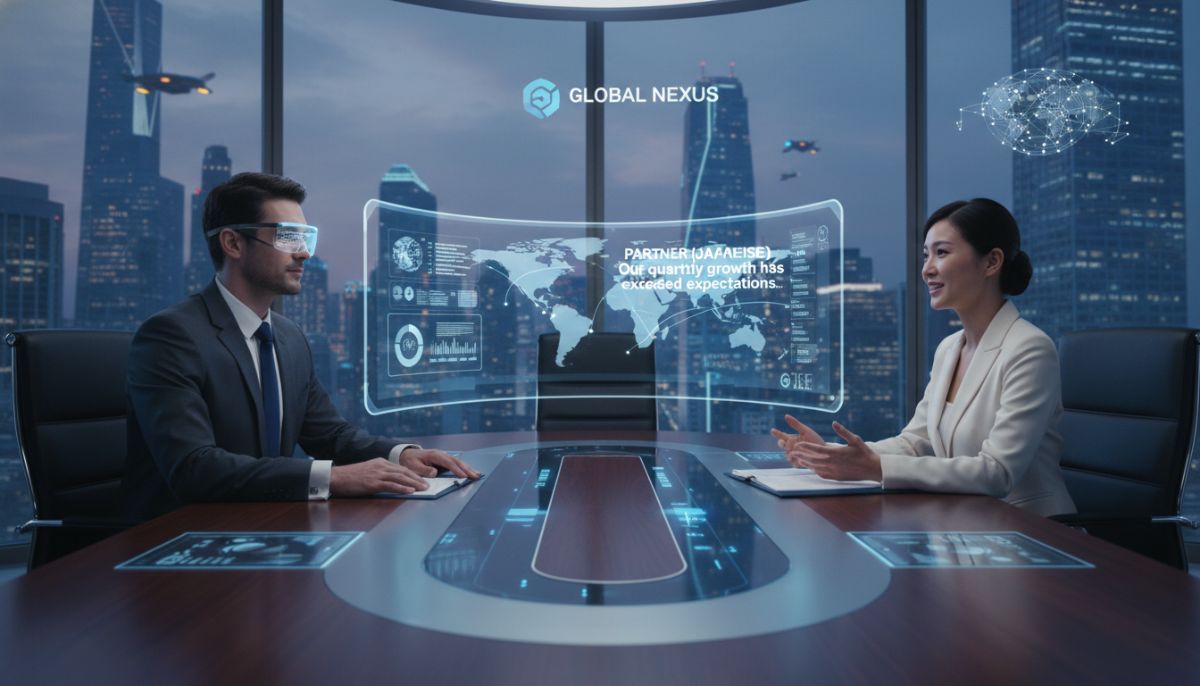
On the hardware side, companies like Timekettle and XRAI Glass are pushing the boundaries of how we interact with translation AI. Timekettle’s specialized earbuds allow two people to speak different languages while hearing the translation directly in their ears, while XRAI Glass utilizes Augmented Reality (AR) to provide real-time captions for the deaf or for those communicating in a foreign tongue, projecting subtitles directly onto the wearer’s field of vision.
Practical Applications Across Industries
The implications of real-time multimodal translation are profound, extending far beyond casual travel. In the corporate world, these tools are neutralizing the ‘language tax’—the cost and time associated with hiring interpreters or the misunderstandings that occur in international negotiations. Real-time translation during video conferences allows for more diverse hiring practices, as a company in Berlin can now seamlessly collaborate with a developer in Hanoi who may not be fluent in German.
In healthcare, multimodal AI can be a lifesaver. In emergency rooms, where every second counts, doctors can use these tools to communicate with non-native speakers, using both voice and visual aids to diagnose conditions accurately. Furthermore, the technology is revolutionizing accessibility. For the hearing impaired, multimodal AI can translate sign language into spoken words or text in real-time, effectively giving a voice to those who rely on visual communication.

Challenges: Accuracy, Latency, and Cultural Nuance
Despite the rapid progress, the road to perfect translation is fraught with challenges. The primary hurdle remains cultural nuance and idiomatic expressions. Language is not just a collection of words; it is a reflection of culture, history, and context. A literal translation of a common idiom can often lead to confusion or even offense. Current AI models are getting better at ‘hallucinating’ less and understanding context more, but they still struggle with regional dialects and slang.
Latency is another critical factor. For a conversation to feel ‘real-time,’ the delay between speech and translation must be under 200 milliseconds. While top-tier models are approaching this speed, network limitations and processing power in mobile devices can still cause lag, breaking the flow of communication. Privacy also remains a significant concern, as these tools often require data to be sent to the cloud for processing, raising questions about who owns the audio and video data being recorded.
The Future: Toward a Post-Language World
As we look toward the future, the goal of multimodal AI translation is to become ‘invisible.’ The ultimate success of this technology will be when users no longer feel like they are using a tool, but rather that the language barrier simply no longer exists. We are moving toward an era of ‘Universal Translators’ akin to those seen in science fiction, where wearable devices and ambient AI provide constant, frictionless interpretation of the world around us.
Integration with Neuralink or other brain-computer interfaces could even one day allow for direct mental translation, though that remains in the realm of long-term speculation. For now, the focus is on refining the accuracy and accessibility of current tools. As these models become more lightweight, they will move from the cloud to ‘on-device’ processing, ensuring faster speeds and better privacy.
Conclusion
Real-time AI multimodal translation tools are more than just a technological novelty; they are a fundamental shift in how humanity connects. By synthesizing audio, visual, and textual data, these tools are dismantling the barriers that have historically divided us. While challenges regarding nuance and data privacy persist, the trajectory is clear: we are entering a post-language era where ideas can flow freely across borders, cultures, and mediums. For businesses, educators, and travelers alike, the world is becoming a much smaller, more understandable place.